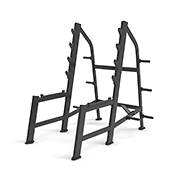
Many gym-goers get confused at first glance when walking into a fitness space: the Smith machine and free-weight power rack share nearly identical heavy steel frame structures, which makes most beginners treat them as interchangeable workout gear. Despite their similar outer appearances, these two core strength-training racks differ drastically in movement paths, muscle activation, training goals and suitable users. Choosing the wrong equipment easily leads to wasted training efforts, slow muscle growth or even unnecessary joint injuries.

The most defining gap lies in barbell movement tracks. A Smith machine fixes its barbell inside vertical steel guide rails, limiting the bar to a straight up-and-down movement without any lateral shift. The locked track removes the need for trainees to stabilize the bar independently during squats, bench presses or overhead presses. New lifters appreciate this built-in stability, as they can focus all energy on pushing or pulling weight instead of balancing the bar. However, the fixed path cuts down core stabilizer muscle engagement significantly. Small supporting muscles around shoulders, core and hips barely activate to maintain balance, lowering overall muscle stimulation for hypertrophy and functional strength improvement.
In contrast, a standard free weight power rack features an open steel frame with adjustable safety spotter arms and J-hooks for barbell placement, with zero restrictions on bar movement. Lifters control every single bar position during workouts, forcing dozens of stabilizer muscles to fire constantly to correct wobbles and keep proper posture. This full-range natural movement matches real-life body mechanics, effectively building overall functional strength, core stability and coordinated muscle groups, which is irreplaceable for long-term fitness progress and athletic performance improvement.
Their applicable training crowds also separate clearly. Smith machines are ideal for total fitness novices, people recovering from sports injuries and those training alone with no workout partner. Beginners can safely test heavy loads without worrying about sudden bar collapse thanks to the guided rail protection, speeding up basic movement pattern learning. Meanwhile, free weight racks serve intermediate and advanced fitness enthusiasts, bodybuilders and competitive strength athletes aiming for maximal muscle gain and raw strength breakthrough. Experienced lifters rely on unconstrained bar movement to break through training plateaus and boost comprehensive physical quality.
Equipment selection directly decides workout efficiency. Use Smith machines for warm-up sets, isolated muscle training and rehabilitation practice; switch to free power racks for main heavy compound lifts like back squats and barbell bench presses. Mixing up these two racks is one of the most common gym mistakes. Once you master their core differences, you can arrange targeted training plans to maximize workout gains and avoid ineffective or risky training routines.